An automated valuation fact sheet for your business · US$79
You built something real.
Here is what it is worth.
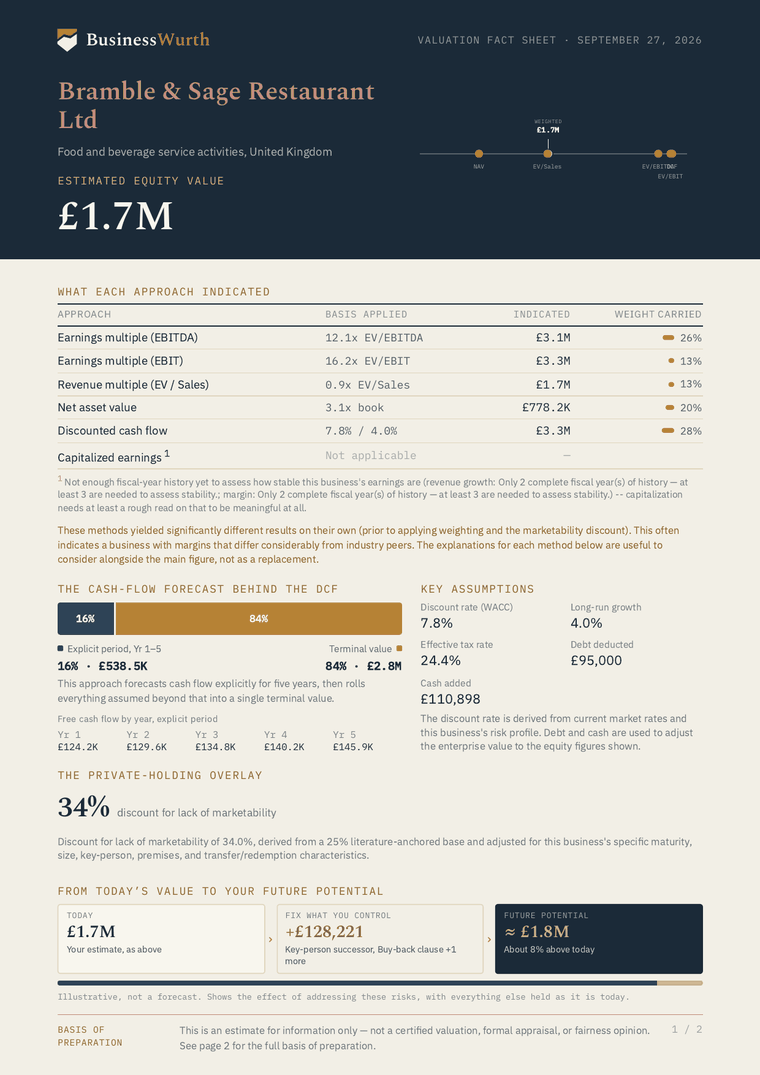
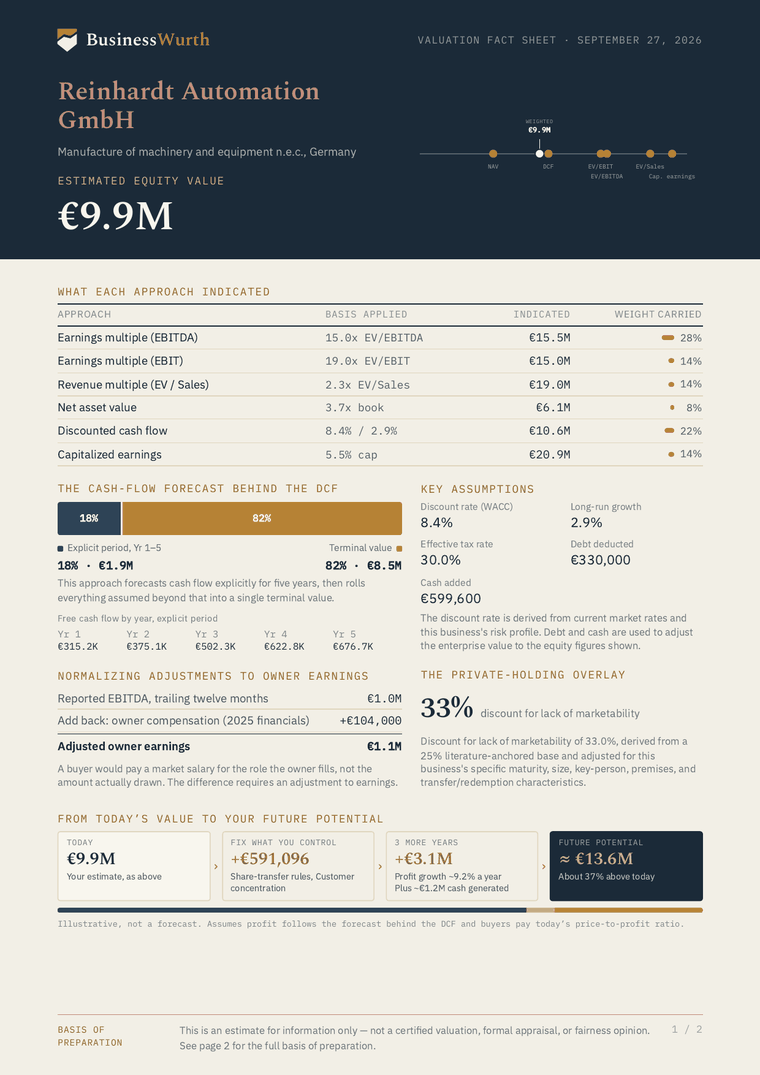
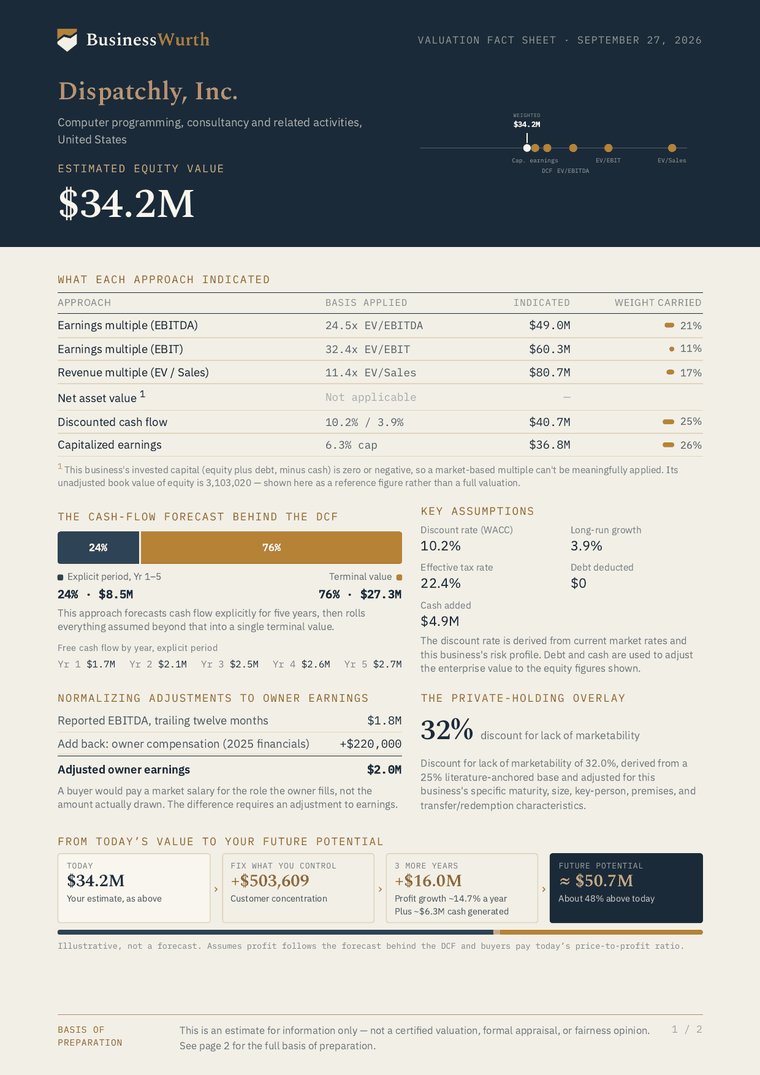
A valuation fact sheet for a private business — several established approaches, compared and blended into one estimate of value. What a mutual fund publishes about its holdings, prepared for the company you own.
In short
- A valuation fact sheet, the way a mutual fund publishes one
- Value, method and key figures on a single sheet. Findings only — no contents page, no long-winded methodology simply making up page numbers.
- AI reads it. You check it. The model values it
- AI is used for one job: reading your accounts, so you can check and confirm the figures. The valuation itself runs through a fixed, tested model built on established valuation methods and published industry data. It doesn't improvise, and the same confirmed figures always produce the same result.
- One weighted figure, not a range
- Every approach is shown, but the headline is the single number they blend into — not a spread left for you to interpret.
What arrives
A valuation fact sheet for the business you own.
Every mutual fund publishes a fact sheet for its holdings: what the position is worth, how that was arrived at, and the figures that matter, on one sheet you can read in a sitting. Private companies get nothing of the sort — only the traditional formal appraisal, where forty pages of content, disclaimers and methodology notes surround the two that hold the findings. This is the fact sheet: the estimate, the approaches behind it, and the numbers that moved it.
Printable, downloadable, and easy to talk through with your accountant or advisor. An informed estimate for your own understanding — not a certified appraisal for a lender, a buyer or a court.
Side one
The valuation
The estimated equity value, blended across approaches
What each approach indicated, and its weight
The cash-flow forecast and key assumptions
Normalizing adjustments to owner earnings
The discount for a private, unlisted holding
From today's value to future potential (illustrative)
Side two
The business behind it
A snapshot of revenue, EBITDA and margins
How revenue breaks down into costs, profit and tax
Your cost breakdown and working-capital measures
Your financial position: what you own and owe
How the marketability discount was built, factor by factor
The basis of preparation and full disclaimer
One blended figure — not an average, not a range · Illustrative example
Each approach lands somewhere different — shown here, not averaged away invisibly. The headline itself is the one weighted figure, not a spread.
Fifteen minutes
Upload your accounts
Twelve months of management accounts and an annual financial statement pack are enough to begin.
Confirm what they say
Follow-up questions generated from your own figures — add-backs, concentration, owner remuneration. A short set of questions about the business itself sets the private-holding discount: verification, not interpretation.
Receive the sheet
A two-page PDF, downloadable and print-ready. Save it, or hand it to your accountant.
The minimum: twelve months of management accounts and one annual financial statement pack. More history gives the estimate more to work with—so upload what you have. Fifteen minutes assumes your accounts are ready to upload; your fact sheet is then available to download from your account as soon as it's generated.
How it is valued
Standard practice, applied properly.
Nothing exotic and nothing invented: the approaches a valuation professional would use, with inputs matched to your industry and where you trade. A general-purpose chatbot can produce a number from a paragraph of description. This produces one from your confirmed accounts, using the same methodology every time, no careful prompt required.
Industry and geography-appropriate multiples
Earnings and revenue multiples drawn from the sector and market you trade in, applied to normalized figures — not one flat multiple for everyone.
Discounted future cash flows
Forecast cash flows brought back to today at a discount rate built for your business, from current market rates and the business's own risk profile.
Capitalized sustainable earnings
Owner-adjusted earnings, capitalized at a rate reflecting your business's own risk and growth outlook. Weighted on its own merits — not merely a cross-check on the figures above.
Asset backing, where it applies
Net asset value anchors the estimate for asset-heavy businesses. Where earnings, not assets, generate the value, this carries little weight in the blend — or does not apply at all.
A private holding overlay
You can't sell a share in a private company on a whim the way you can with a listed one. That difference is priced, as valuation practice requires.
Your data
It stays yours, and is deleted anytime you want.
Deletable whenever you choose
Documents, extracted figures, the finished sheet, the account itself. Removed in full, from My Data, whenever you choose.
Encrypted in transit
Every upload travels over HTTPS from your device. Nothing crosses the wire in the clear.
A private account, not a link
Your figures are visible only to your account—no shared URLs.
Never AI training data
Your accounts are never sold, and never used to train any AI model, ours or anyone else's. They're used only to produce your sheet.
Insights
All insights →Short, practical notes on what actually moves a valuation — written for owners, not analysts.
Why do business appraisals cost so much?
A formal appraisal can run past $15,000. Here's what the fee actually pays for, typical ranges in the US and UK, and when you actually need one.
Which revenue goes into a revenue multiple?
“Revenue times a multiple” sounds simple until you ask which revenue. A worked seasonal example shows how last month, last quarter, last year and a trailing twelve months can disagree by hundreds of thousands.
Understanding DLOM
Every valuation applies a discount most owners have never heard of. Where the 25% base rate actually comes from, why one flat number doesn't hold up, and a worked example showing a $360,000 swing between two otherwise identical businesses.
No subscription, no tiers, nothing withheld for a higher plan. Signing up and uploading are free—you're charged once per valuation, before your documents are processed. A later revaluation of the same business is charged again at the same price.
Price in US dollars, including any applicable sales tax or VAT. Payments are processed by Paddle.com, our Merchant of Record, which handles billing, tax and refunds. See our Refund Policy.
An automated estimate for information only — not a certified appraisal, and not financial, investment, tax or legal advice.
Launching soonSuited to · not suited to